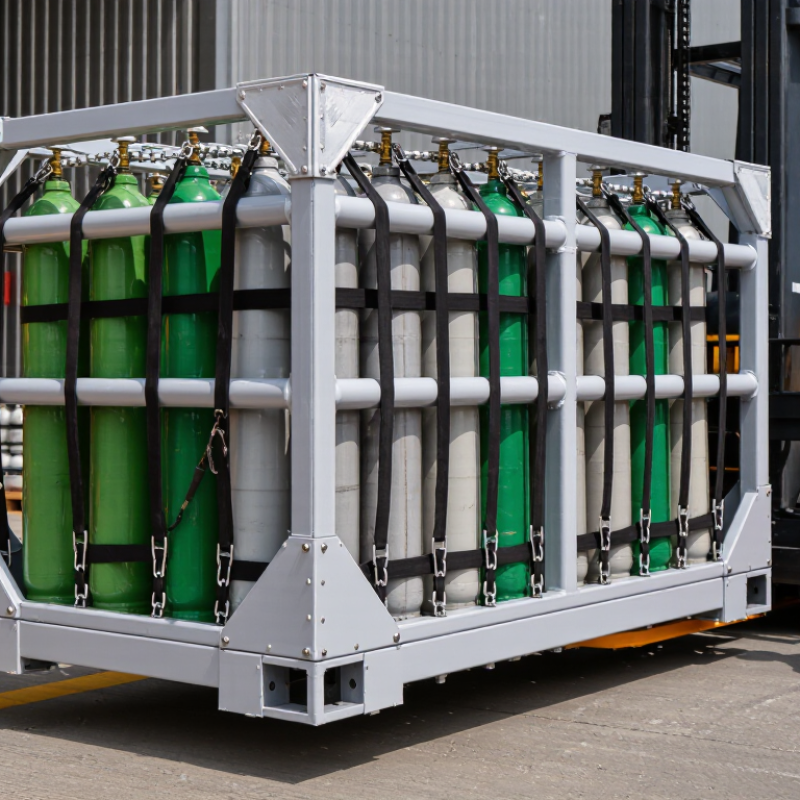
A Gas Cylinder Transportation Frame is a purpose-built support structure for moving gas cylinders safely and efficiently. It keeps cylinders upright, grouped, and restrained during handling, storage, and short-distance transport. Unlike improvised pallets or loose chains, a properly designed frame offers defined contact points, protective rails, and secure fastening systems.
In practical use, workers may load the frame with a forklift, crane, or pallet truck. Steel tubing, reinforced corners, and forklift pockets help the frame withstand repeated handling. Straps or chains should hold each cylinder firmly without damaging its valve or surface. Small details matter. A missing pin can create movement. A worn strap can fail unexpectedly.
The best frames match the cylinder size, quantity, valve arrangement, and handling method. Load capacity must be checked before use. The frame should also remain stable on uneven ground, inside a service yard, or on a vehicle deck. Experienced operators inspect welds, locking points, labels, and base plates before every movement. They also follow the cylinder supplier’s instructions and applicable transport requirements.
However, a frame does not make unsafe handling acceptable. It cannot replace training, risk assessment, or correct cylinder preparation. Designs differ widely, and one model may not suit every cylinder type. This point is sometimes overlooked. A reliable selection process considers real working conditions, not only the advertised capacity.
This guide explains what a Gas Cylinder Transportation Frame does, how its main components work, and which practical features deserve careful attention. The goal is simple: safer handling, better organization, and fewer avoidable mistakes.
What Is a Gas Cylinder Transportation Frame?
Definition and Purpose of a Gas Cylinder Transportation Frame
A gas cylinder transportation frame is a support structure designed to move cylinders safely. It usually includes a rigid base, upright supports, retaining straps, and handles or wheels. Some models also provide lifting points for controlled mechanical handling. The frame keeps cylinders vertical and limits rolling, tipping, and sliding during movement.
Its main purpose is protecting both the cylinder and the people nearby. A secure frame can reduce impact damage to the cylinder wall, valve, and protective cap. It also makes heavy cylinders easier to guide across uneven floors, loading areas, and narrow corridors. Proper restraints matter. One loose strap can allow a cylinder to shift unexpectedly. That small movement may create a serious handling problem.
Safe use begins with checking the frame’s load rating and condition. Look for bent tubing, damaged wheels, worn straps, and weak connection points. Place compatible cylinders inside the frame, keep them upright, and secure each one firmly without crushing it. The frame should remain balanced while moving. It is not a replacement for trained handling or applicable safety requirements. A frame cannot correct poor loading practices. It is easy to trust the equipment too much. In real workplaces, rushed inspections are still a frequent weakness. Clear procedures, suitable protective equipment, and careful route planning remain essential.
A gas cylinder transportation frame is a steel structure that keeps cylinders upright, separated, and restrained during movement. Its design starts with a stable base, not decorative tubing. The base must distribute weight across the floor and resist tipping during braking or turning. Upright posts carry vertical loads, while cross-braces limit sideways movement. Low centers of gravity matter.
Key components include saddles, retaining chains, collars, and adjustable straps. Each contact point should hold the cylinder without crushing its surface. Rubber or polymer pads can reduce vibration and metal-to-metal impact. Forklift pockets or lifting lugs should connect directly to reinforced frame members. They must support the rated load without twisting the structure. Open sides improve visibility and ventilation. Clear access also helps workers inspect valves and restraints.
A practical frame needs a clear load path from the cylinder supports to the lifting points. Sharp edges should be removed. Drainage holes can reduce trapped water and corrosion. Coatings help, but they are not a substitute for inspection. Welds, fasteners, hinges, and chains deserve regular checks. A frame may look strong and still contain a weak joint. That is easy to miss. Design verification should consider cylinder size, filled weight, impact forces, handling equipment, and the operating environment. Engineers should confirm these details against applicable transport and workplace requirements. Field experience often reveals problems drawings overlook, such as poor hand clearance or straps that loosen after repeated vibration.
| Design Dimension | Key Component or Feature | Primary Function | Typical Materials | Common Design Data or Criteria | Inspection and Safety Considerations |
|---|---|---|---|---|---|
| Load Capacity | Frame body and load-bearing members | Supports the combined weight of cylinders, valves, guards, and accessories during lifting and transport. | Structural carbon steel or low-alloy steel | Rated working load should exceed the maximum gross operating load, including an appropriate engineering safety margin. | Check the nameplate or design documentation for the rated load. Do not exceed the working load during loading, lifting, or stacking. |
| Cylinder Retention | Horizontal straps, chains, bars, or individual restraints | Prevents cylinders from rolling, shifting, or falling out of the frame. | Steel bars, galvanized chains, polyester webbing, or coated restraint hardware | Each cylinder should be positively restrained at suitable points, with restraints positioned to control both lateral and longitudinal movement. | Inspect for stretched webbing, damaged chains, loose fasteners, worn hooks, and inadequate tension. Restraints must not contact or damage cylinder valves. |
| Cylinder Orientation | Vertical pockets, cradles, or locating rings | Keeps cylinders in the intended upright or specified transport position. | Formed steel plate, tube sections, rubber pads, or polymer liners | The locating geometry should prevent excessive movement while allowing the cylinder to be loaded and removed without impact. | Confirm that the frame is suitable for the cylinder type and diameter. Cylinders should not rest directly on sharp edges or protruding welds. |
| Base Structure | Bottom rails, skid beams, cross-members, and cylinder feet support | Distributes the load and provides a stable contact surface for storage, handling, and transport. | Rectangular hollow sections, angle steel, channel steel, or formed plate | The base should resist bending and local deformation under the full loaded condition and remain stable on the intended supporting surface. | Look for bent rails, cracked welds, severe corrosion, missing support pads, and deformation that could make the frame unstable. |
| Forklift Handling | Fork pockets or forklift entry channels | Allows controlled movement by forklift while keeping the frame balanced. | Reinforced structural steel sections | Pocket spacing, internal clearance, and reinforcement must match the designated forklift capacity and fork dimensions. | Fork pockets should be clearly marked where required. Forks must be fully inserted and positioned symmetrically before lifting. |
| Crane Handling | Lifting lugs, lifting eyes, or certified lifting points | Provides a controlled connection for cranes, slings, or spreader beams. | Welded structural steel lifting plates or forged lifting eyes | Lifting points must be designed for the complete loaded frame, including dynamic effects and the selected sling arrangement. | Inspect lifting points for distortion, cracks, corrosion, illegible markings, and unauthorized repairs. Use only approved lifting accessories. |
| Impact Protection | Perimeter posts, corner guards, and upper protective rails | Protects cylinders, valves, and connected equipment from impact during handling and transport. | Steel tube, pipe, plate, or energy-absorbing polymer guards | Guards should extend beyond vulnerable valve areas without obstructing inspection, connection, or emergency access. | Check that guards are securely attached and do not interfere with pressure relief devices, valve caps, hoses, or cylinder identification markings. |
| Valve Protection | Valve guard, cap clearance, or protective canopy | Reduces the risk of valve breakage and unintended gas release caused by impact or snagging. | Steel guard assemblies or approved cylinder protection components | The protection arrangement must provide sufficient clearance for the installed valve and its required cap or guard. | Never use the valve, valve cap, or regulator as a lifting or securing point. Verify that protective components are correctly installed. |
| Tie-Down Interface | Lashing eyes, side rails, or transport restraint points | Connects the loaded frame to a vehicle deck or other approved transport restraint system. | Steel lashing rings, plates, or reinforced rails | Tie-down points should transfer transport forces into the main frame without causing local tearing, bending, or instability. | Use a restraint arrangement suitable for the vehicle and route. Check that lashings are protected from sharp edges and remain tensioned. |
| Stacking Arrangement | Stacking feet, locating pins, or corner posts | Controls the position of frames placed above one another and transfers vertical loads. | Structural steel posts, plates, and locating components | Stacking is permitted only when the frame is specifically designed and marked for it; load paths must align between upper and lower frames. | Do not stack damaged or incompatible frames. Confirm the permitted number of layers and the required ground condition. |
| Ventilation | Open-sided panels, mesh sections, and drainage gaps | Allows air circulation and helps prevent the accumulation of released gas within enclosed areas. | Expanded metal, welded mesh, perforated plate, or open structural sections | The design should avoid creating an enclosed pocket around cylinders and should maintain access for inspection and connection work. | Keep ventilation openings clear of packaging, ice, dirt, and temporary covers. Gas-specific handling procedures still apply. |
| Corrosion Protection | Surface preparation, coating system, and drainage design | Extends service life and preserves structural strength in outdoor or humid environments. | Painted steel, zinc-coated steel, or duplex coating systems | Coating selection should reflect exposure conditions, handling frequency, and contact with moisture, salt, or industrial contaminants. | Inspect weld toes, drain areas, frame corners, and damaged coating zones. Remove corrosion before it reduces section thickness. |
| Welded Connections | Fillet welds, full-penetration welds, gussets, and stiffeners | Joins the frame members and transfers lifting, handling, and transport loads. | Weldable structural steel with compatible filler materials | Weld sizes and joint details should be determined from calculated loads, fatigue exposure, member thickness, and the selected fabrication procedure. | Look for visible cracks, undercut, porosity, incomplete welds, and corrosion at weld toes. Repairs should be performed by qualified personnel. |
| Identification and Marking | Frame identification plate, load rating, handling symbols, and hazard labels | Communicates the frame’s capacity, handling limits, inspection status, and contents-related safety information. | Metal plate, durable label, stamped marking, or weather-resistant coating | Markings should remain legible and include relevant capacity, tare information, lifting instructions, and inspection details where required. | Replace missing or unreadable markings. Cylinder labels and hazard communication information must remain visible and unobstructed. |
| Drainage and Cleanability | Drain holes, open sections, removable trays, and accessible surfaces | Prevents water and contaminants from accumulating inside the frame. | Open structural sections, formed plate, or corrosion-resistant fittings | Drain paths should not compromise structural members and should allow routine cleaning and visual inspection. | Clear blocked drains and remove debris. Accumulated moisture can accelerate corrosion around welds, pockets, and cylinder supports. |
| Design Verification | Load calculations, stability assessment, prototype testing, and inspection plan | Confirms that the frame performs safely under expected lifting, transport, and environmental conditions. | Engineering documentation and qualified inspection methods | Verification should consider static load, handling forces, braking and acceleration effects, stability, clearance, and foreseeable misuse. | Maintain records of design approval, fabrication inspection, repairs, periodic examination, and any change to the original configuration. |

What Is a Gas Cylinder Transportation Frame?
How Gas Cylinders Are Secured for Transport
A gas cylinder transportation frame is a rigid structure that keeps cylinders upright, separated, and stable during movement. It may include a base, vertical supports, chains, straps, and protective rails. The frame should match the cylinder size and load weight. A loose fit creates dangerous movement.
Experienced handlers inspect the frame before loading. They check welds, fasteners, anchor points, and signs of corrosion. Cylinders are placed upright, with valves facing away from impact areas. Valve caps or guards must remain fitted when required. Keep valves protected. Cylinders should never rest directly on sharp metal edges.
Straps or chains hold each cylinder against the frame, not just against nearby cylinders. They must be tight without crushing the cylinder surface. Heavy cylinders belong in lower positions when the frame design allows it. The load should stay balanced across the vehicle floor. Small movements matter. A frame can look secure while allowing hidden vibration.
The vehicle should prevent shifting, tipping, and contact with hot surfaces. Suitable ventilation is also important, especially when transporting compressed gases. Handlers should check cylinder labels, condition, and compatibility before loading. Damaged cylinders need separate professional assessment. Never rely on weight alone. After a short distance, a trained operator should recheck the restraints. I still treat this step as essential, because a rushed inspection can miss one loose buckle. Follow the applicable transport rules and the cylinder supplier’s safety data.
A transportation frame keeps cylinders upright, separates them from one another, protects valves, and helps resist movement during road transport.
The chart shows commonly referenced cargo-securement acceleration criteria used for road cargo in the United States: 0.8 g forward, 0.5 g rearward, and 0.5 g laterally. Actual requirements may vary by jurisdiction, cylinder type, vehicle, and applicable hazardous-material regulations.
What Is a Gas Cylinder Transportation Frame?
A gas cylinder transportation frame is a rigid support structure for moving cylinders safely. It helps prevent rolling, tipping, and impact damage during handling. Most frames use steel or aluminum tubing, protective bars, and adjustable retaining chains. Some include forklift pockets, lifting eyes, or caster wheels. The correct design depends on cylinder size, weight, valve protection, and transport distance.
Types of Transportation Frames and Their Applications
Single-cylinder frames suit workshops, laboratories, and short-distance service work. They are compact and often include two wheels, a handle, and a securing strap. Multi-cylinder frames carry several cylinders together. They work well in hospitals, fabrication areas, and maintenance facilities where organized movement matters. Palletized frames support larger groups and allow forklift handling. They are useful for warehouses, distribution yards, and scheduled site deliveries.
Enclosed frames provide extra protection in busy work areas. Their mesh sides reduce accidental contact while keeping the cylinders visible. Open frames offer faster loading and easier inspection. Some mobile frames are designed for stairs or uneven floors, but their balance must be checked carefully. In field inspections, loose chains and worn welds are common warning signs. A frame may look secure and still be unsuitable. Check the cylinder fit, frame rating, center of gravity, and restraint points before movement. Small gaps can become serious problems on ramps. I would also recheck the load after the first few meters, because vibration can loosen hardware.
A gas cylinder transportation frame is a rigid structure that keeps cylinders upright during movement. It usually includes supports, retaining chains, lifting points, and a stable base. In practical handling, the frame should prevent rolling, sliding, and sudden impact. Safety begins with choosing a frame designed for the cylinder size and load. Follow applicable workplace rules, transport regulations, and the manufacturer’s instructions. Trained workers should inspect the frame before every use. A loose chain can create a serious hazard within seconds.
Handling procedures must remain controlled and deliberate. Secure each cylinder separately, even when several cylinders share one frame. Keep valves protected and position cylinders away from sharp edges. Use approved lifting equipment and never drag the frame across uneven ground. Operators should check the route for ramps, wet floors, door thresholds, and overhead obstructions. I have found that rushed movement often causes more damage than heavy lifting. No procedure is perfect. A second person can notice risks that the operator misses.
Tips: Keep an inspection log. Check welds, wheels, chains, pins, and labels. Remove damaged frames from service immediately. Clean dirt and moisture from contact points, then store the frame in a dry, ventilated area. Lubricate moving parts only when suitable for the environment. Review the procedure after any near miss, because small failures often reveal larger weaknesses.