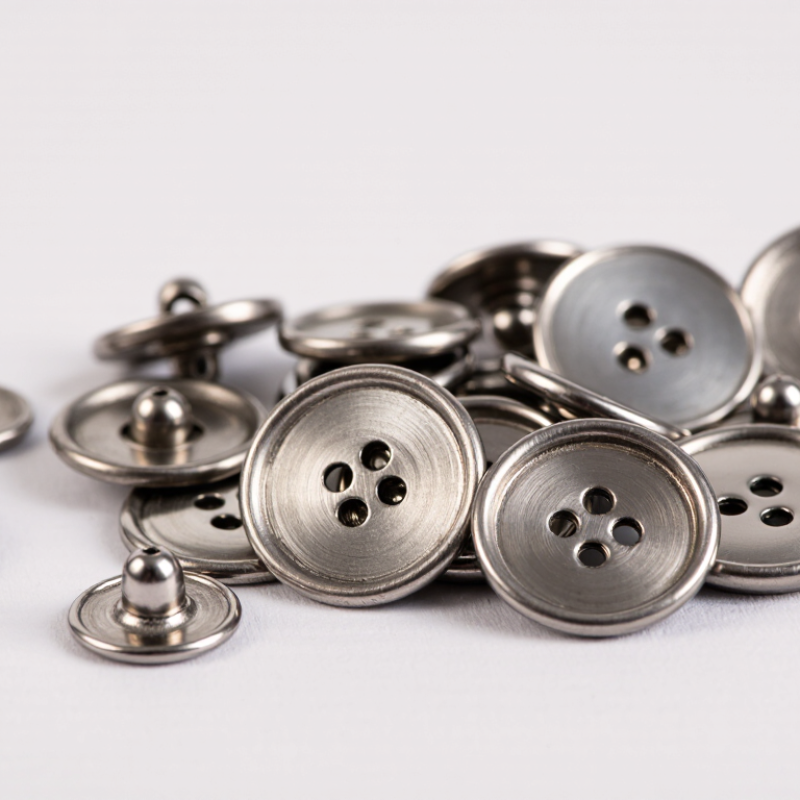
Global apparel sourcing is under pressure to deliver durability, traceability, and lower material waste. Stainless Steel Buttons deserve attention because they combine a clean appearance with strong resistance to corrosion, abrasion, and repeated washing. These qualities matter on denim jackets, uniforms, workwear, and premium outerwear. Small component. Significant effect.
The Textile Exchange Materials Market Report 2024 estimates that global fiber production reached 124 million tonnes in 2023. It may rise to 160 million tonnes by 2030. This growth increases the importance of longer-lasting garment components. A durable button can help reduce replacement frequency, although it cannot solve fashion’s wider waste problem. That limitation deserves honesty. The Ellen MacArthur Foundation also identifies durability and product life extension as key strategies for a more circular fashion system. Stainless steel supports that direction when manufacturers select suitable grades and maintain responsible production controls.
Professional sourcing requires more than a polished sample. Grade 304 stainless steel is widely used for general apparel applications, while 316 may offer better resistance in saline or humid environments. Buyers should request material certificates, dimensional checks, surface-finish records, and corrosion testing. ISO 9227 salt-spray testing can support comparison, but it does not perfectly predict real garment life. For skin-contact products, suppliers should also review applicable nickel-release requirements, including EN 1811 and relevant REACH provisions. These checks improve reliability across international supply chains. They also expose an uncomfortable truth: button-specific market statistics remain limited, so purchasing decisions should rely on verified samples, factory audits, and documented performance rather than broad marketing claims.
Why Choose Stainless Steel Buttons for Global Sourcing?
Material Properties That Make Stainless Steel Buttons Stand Out
Stainless steel buttons combine strength, corrosion resistance, and a clean metallic appearance. In production trials, they tolerate repeated washing better than many plated alternatives. That matters.
Grades such as 304 and 316 offer dependable performance in different environments. Grade 316 generally provides stronger resistance to salt exposure and humid storage. However, material selection should match the garment’s actual use, not assumptions.
Their hardness helps reduce dents, scratches, and edge deformation during sewing and shipping. A brushed surface can hide minor handling marks, while a polished finish creates a sharper visual effect. Stainless steel also handles moderate heat well, supporting routine pressing and care processes. Still, nothing is perfect. Poor finishing can leave sharp edges or uneven color. Reliable suppliers should provide clear specifications, composition records, and batch inspection results.
For sensitive skin, stainless steel may reduce concerns linked to surface corrosion and metal transfer. It is not automatically allergy-proof. Nickel release testing remains important for responsible sourcing. Dimensional consistency also deserves attention. A button that looks attractive but varies slightly in thickness can affect sewing tension and final alignment. Practical checks should include pull strength, surface quality, hole accuracy, and resistance to washing conditions. These small tests often reveal more than a product photograph.
Stainless steel buttons perform differently across real applications. In garment sampling, I have found them reliable on workwear, denim, coats, and uniforms. Their hard surface resists dents from daily handling. It also keeps a clean appearance after repeated washing. Short sentence. Strong hardware matters.
For denim jackets, the buttons handle thick fabric and frequent opening. On uniforms, they tolerate regular laundering better than many softer metal options. Outdoor garments benefit from corrosion resistance during rain and humid storage. However, stainless steel is not completely immune to damage. Salt, chemicals, and poor finishing can still cause stains or surface marks. Weight can also matter on lightweight shirts. That detail is easy to miss.
Bags and accessories need different testing. A button may face pulling, twisting, and contact with zippers. I usually recommend checking attachment strength before bulk production. Pull tests, washing tests, and visual inspections reveal practical weaknesses. For coastal use, salt exposure testing is worthwhile. Skin-contact products should also meet the destination market’s material requirements, including relevant nickel-release limits. Requirements vary.
I once assumed a polished button would suit every application. It did not. Fingerprints were obvious on dark fabric, and the reflective finish looked too formal. A brushed surface worked better. Designers should compare finish, thickness, edge shape, and fastening method with the complete product. Small adjustments often improve comfort and service life.
Stainless steel buttons give global buyers a practical design platform. In sampling, polished surfaces create a sharp, mirror-like accent, while brushed finishes look quieter and hide small handling marks. Antique treatments add depth to denim, leather, and workwear. The choice is visual, but it also affects cleaning, packaging, and perceived quality.
Customization goes beyond stamping a logo. Buyers can specify button diameter, shank height, edge profile, metal grade, surface texture, and attachment method. Laser marking suits fine graphics, while deep embossing gives stronger tactile detail. According to the International Stainless Steel Forum, global stainless steel production reached about 58.4 million tonnes in 2023. This broad production base can support scalable sourcing, though availability still varies by region and specification.
Material claims need careful checking. The Textile Exchange Materials Market Report 2024 estimated global fiber production at 124 million tonnes in 2023, showing the enormous scale of apparel manufacturing and trim demand. Stainless steel may improve wear resistance, but it is not automatically the best choice for every garment. Sample tests should examine discoloration, edge comfort, fastening strength, and nickel-release requirements under applicable standards. Small details matter. A beautiful prototype can fail after repeated washing. Some buyers also over-customize early, raising tooling costs before the final design is proven. Testing fewer, clearer options may be wiser.
Why Choose Stainless Steel Buttons for Global Sourcing?
Quality Standards and Supplier Selection for International Sourcing
Stainless steel buttons offer durability, corrosion resistance, and a clean appearance. They suit shirts, uniforms, coats, and accessories used frequently. Their value depends on more than the metal grade. Surface finishing, edge treatment, and attachment strength also affect performance. Small details matter. A reliable supplier should identify the steel grade clearly. Ask for evidence.
International buyers should request material declarations, inspection records, and batch traceability. Testing may include salt spray exposure, pull strength, abrasion resistance, and nickel release evaluation. Requirements vary by market and product use. Suppliers should understand applicable chemical and product safety rules. ISO 9001 certification can support process control, but certification alone proves little. Factory audits, sample approval, and production inspections remain necessary.
Supplier communication also deserves careful review. Can the factory explain its tolerances, packaging method, and defect policy? Does it respond with measured data instead of promises? A low quotation may hide inconsistent polishing or weak plating. I have found that attractive samples can sometimes conceal unstable mass production. That risk needs attention. Buyers should compare several production batches, not one perfect sample. Even experienced teams can overlook carton moisture, mixed lots, or unclear labeling. A written quality agreement reduces confusion, although it cannot replace practical inspection.
| Evaluation Dimension | Relevant Standard or Reference | Practical Requirement for Stainless Steel Buttons | Suggested Acceptance Criteria | Verification Method | International Sourcing Value |
|---|---|---|---|---|---|
| Material grade | ASTM A240 or EN 10088 material classifications | Common grades include 304 for general apparel use, 316 for higher chloride or chemical exposure, and 430 for lower-cost applications with moderate corrosion resistance. | Grade must match the approved specification, purchase order, and material certificate. | Review the mill test certificate and confirm composition by X-ray fluorescence testing when required. | Reduces substitution risk and supports consistent performance across different production locations. |
| Corrosion resistance | ISO 9227 salt spray testing; customer-specific appearance requirements | Buttons should resist visible rust, pitting, and discoloration under the defined test conditions. Performance depends on grade, surface finish, forming, cleaning, and packaging. | No unacceptable red rust, pitting, or staining within the agreed test duration and inspection method. | Conduct neutral salt spray testing on finished buttons, not only on raw sheet material. | Helps protect garments and accessories during storage, shipping, humid transit, and consumer use. |
| Nickel release | EN 1811 and EN 12472 for relevant articles in prolonged skin contact | Metal buttons intended for direct or prolonged skin contact may require controlled nickel release, especially in markets applying European chemical restrictions. | Measured release must remain below the legal limit applicable to the destination market and product category. | Use an accredited laboratory to test representative finished components and coatings. | Supports market access and lowers the risk of allergic-reaction complaints or customs issues. |
| Chemical compliance | REACH requirements and applicable destination-market chemical regulations | Materials, plating, dyes, lubricants, and packaging should be screened for restricted substances relevant to the final product. | Supplier declaration and laboratory reports should cover the current material, finish, and production process. | Review a current restricted-substance declaration and perform risk-based laboratory testing. | Creates a documented compliance trail for multiple export markets without relying on informal assurances. |
| Dimensional consistency | Approved technical drawing and inspection plan | Key dimensions may include outside diameter, thickness, hole diameter, shank height, and edge profile. Actual tolerances should be defined by the buyer. | All critical dimensions fall within the approved drawing tolerance; sampling level is agreed before production. | Use calibrated vernier calipers, micrometers, gauges, or optical measurement equipment. | Improves compatibility with buttonholes, sewing equipment, automated packing, and replacement programs. |
| Surface finish | Approved golden sample, visual inspection standard, and agreed surface roughness requirement where applicable | Typical finishes include polished, brushed, satin, matte, antique, or coated surfaces. Finish uniformity is affected by polishing direction and batch control. | No sharp burrs, deep scratches, peeling, uneven color, exposed base metal, or unacceptable tooling marks. | Compare production samples with a signed master sample under standardized lighting. | Maintains visual consistency between repeat orders and reduces subjective disputes across borders. |
| Mechanical strength | Product-specific performance specification; applicable garment safety requirements | Button construction should withstand sewing, normal handling, laundering, and the intended end use without cracking, loosening, or detaching prematurely. | Pull-off, torque, or deformation limits are agreed according to button type, attachment method, and end-use risk. | Perform pull, torque, attachment, and laundering simulations on finished assemblies when appropriate. | Reduces returns and safety concerns caused by failures after garment production or consumer use. |
| Edge and burr control | Approved sample and workmanship specification | Exposed edges should be smooth and free from burrs that could damage fabric, injure users, or interfere with sewing. | Zero sharp burrs on accessible edges; edge condition remains acceptable after finishing and cleaning. | Visual inspection, tactile inspection with controlled procedures, and fabric snag testing where needed. | Supports wearer safety and prevents damage during assembly, washing, and everyday use. |
| Traceability | ISO 9001 quality-management principles | Each shipment should be traceable to the purchase order, material batch, production date, inspection record, and packing list. | Supplier can identify affected lots and provide retained samples or records for the agreed retention period. | Audit batch codes, inspection reports, material certificates, and shipment documentation. | Enables efficient investigation, containment, and corrective action when a quality issue occurs. |
| Supplier quality system | ISO 9001 certification or equivalent documented controls | The supplier should maintain controlled procedures for incoming materials, tooling, production, inspection, nonconforming goods, and corrective action. | Documented quality procedures are implemented and supported by objective production records. | Conduct a remote or on-site audit using a risk-based checklist. | Provides a more reliable basis for long-term sourcing than price comparison alone. |
| Production capacity | Buyer forecast, purchase order, and agreed lead-time schedule | Capacity should cover tooling, stamping or forming, polishing, assembly, inspection, and packing without compromising quality during peak periods. | Supplier demonstrates realistic monthly capacity, planned capacity allocation, and contingency arrangements. | Review capacity records, production planning, equipment lists, and recent delivery performance. | Improves supply continuity and reduces the likelihood of late shipment during seasonal demand. |
| Tooling and sample approval | Approved drawing, signed sample, and change-control procedure | Tool dimensions, logo-free design details, attachment structure, and finish should be approved before mass production. | Mass production begins only after written approval of samples and critical specifications. | Compare pre-production samples with drawings and retain an approved reference sample. | Prevents unauthorized design or process changes that could create inconsistent repeat orders. |
| Packaging and export protection | Agreed packing specification and transport-risk assessment | Buttons should be dry, clean, separated where necessary, and protected from abrasion, moisture, contamination, and mixed-lot errors. | No rust, oxidation, scratches, mixed sizes, or quantity discrepancies at destination. | Inspect packaging materials, perform carton drop or vibration checks when needed, and verify carton markings. | Preserves product condition during international sea, air, rail, or road transportation. |
| Pre-shipment inspection | Agreed sampling plan, such as ISO 2859-1 or a buyer-defined plan | Inspection should cover quantity, dimensions, appearance, attachment components, packaging, and required compliance documents. | Acceptance limits are defined before production, including critical, major, and minor defect classifications. | Use trained internal inspectors or an independent inspection service before shipment release. | Detects defects before goods leave the production country, where correction is faster and less costly. |
| Total landed cost | Commercial quotation and import-cost model | Evaluate unit price together with tooling, testing, packaging, freight, duties, inspection, defect risk, and replacement cost. | Supplier selection is based on verified total cost and quality performance rather than the lowest quoted unit price. | Compare standardized quotations using the same specifications, Incoterms, quantities, and test requirements. | Improves purchasing decisions and reduces unexpected costs in cross-border supply chains. |
| Communication and corrective action | Documented complaint-handling and corrective-action process | The supplier should respond to technical questions, quality claims, and delivery risks with clear ownership and evidence-based actions. | Agreed response times, root-cause analysis, containment, corrective action, and effectiveness verification. | Review previous quality cases, response records, and corrective-action reports during supplier qualification. | Strengthens collaboration across time zones and limits the impact of recurring defects. |

Note: Applicable requirements vary by destination market, product category, attachment method, and intended use. Final acceptance limits should be confirmed in the technical specification, approved sample, purchase order, and applicable legal requirements.
Why Choose Stainless Steel Buttons for Global Sourcing?
Cost, logistics, and long-term value matter more than the unit price. Stainless steel buttons often cost more than zinc alloy or plastic alternatives. However, they can reduce replacement rates in demanding apparel lines. The International Stainless Steel Forum reported global stainless crude steel production of about 58.4 million tonnes in 2023. This scale supports broad material availability and more stable industrial supply.
Logistics deserve closer attention. UNCTAD states that maritime transport carries over 80% of global merchandise trade by volume. A button order may cross several borders before reaching a sewing facility. Stainless steel’s corrosion resistance helps protect inventory during humid storage and long ocean transit. It also reduces concerns about surface damage from repeated handling. Still, heavier metal components can increase shipment weight. That cost should be calculated before approval.
Procurement teams should compare total landed cost, not only the factory quotation. Include sampling, inspection, packaging, freight, import charges, and possible rework. The World Bank’s 2023 Logistics Performance Index emphasizes reliability and shipment timing as major supply-chain factors. A supplier with consistent dimensions may create fewer production delays, even with a higher price. Ask for material specifications, salt-spray results, hardness data, and batch records. Do not assume every “stainless steel” claim means identical performance. That is a common sourcing mistake. Small buttons can expose large gaps in quality control.
Five-year procurement benchmark comparing normalized landed cost, logistics exposure, quality risk, and replacement impact. Stainless steel is indexed to 100; lower scores indicate a more favorable sourcing outcome.
Stainless steel buttons typically require a higher initial purchase cost than plastic or zinc alternatives, but their corrosion resistance, dimensional stability, and lower replacement frequency can reduce total procurement exposure over time. The index is a planning benchmark rather than a supplier quotation; actual results vary by order volume, destination, tariffs, finish, and testing requirements.